
Play is an important part of a baby’s early development. Through simple activities and age-appropriate toys, babies gradually explore their surroundings, recognise sounds, develop coordination and interact with people and objects.
Choosing suitable educational toys for babies is not simply about purchasing colourful or expensive products. Parents should consider their baby’s age, developmental abilities, interests and safety requirements before making a selection.
From high-contrast picture toys and soft rattles for younger babies to stacking cups, activity toys and interactive books for older infants, different toys can provide opportunities to practise emerging skills.
In this guide, we explore educational toys for babies at different developmental stages, the features parents should compare, important toy safety considerations and common purchasing mistakes.
Our aim is to help parents choose engaging, practical and safe toys that encourage learning through everyday play without unnecessary spending.
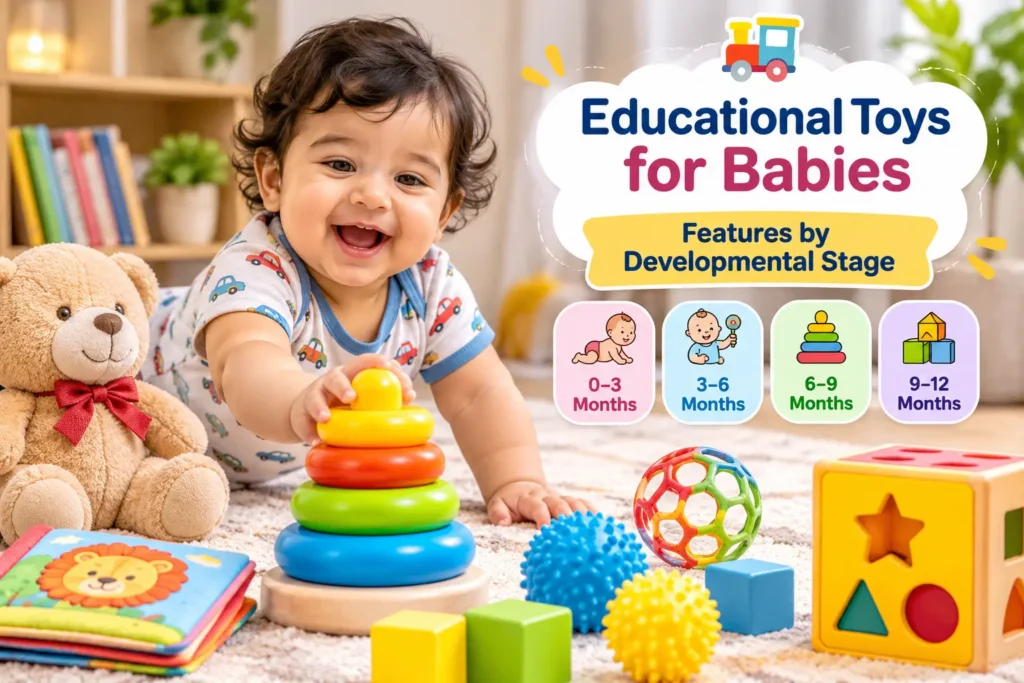
1. Understand the Importance of Educational Toys for Babies
Babies learn by observing, listening, touching, reaching and interacting with their surroundings. Simple play experiences give them opportunities to practise different skills as they grow.
Educational toys can support several areas of early development.
- Sensory exploration: Toys with different colours, sounds and textures allow babies to explore their senses.
- Motor development: Reaching, grasping, holding and moving toys help babies practise physical coordination.
- Cognitive development: Simple activities involving objects, shapes and movement encourage exploration and problem-solving.
- Language development: Picture books, sounds, songs and conversations during play expose babies to words and communication.
- Social interaction: Playing with parents and caregivers encourages interaction, turn-taking and emotional connection.
- Curiosity and creativity: Open-ended toys allow babies to explore objects in different ways as their abilities develop.
It is important to remember that toys do not guarantee particular developmental outcomes. Babies develop at different rates, and interaction with parents and caregivers remains an essential part of early learning.
2. Choose Educational Toys for Babies Aged 0–3 Months
During the first few months, babies gradually become more attentive to faces, voices, colours and movement.
They begin observing their surroundings and responding to familiar sounds and interactions.
At this stage, toys should be simple, lightweight and visually engaging.
2.1 High-Contrast Visual Toys
High-contrast black-and-white picture cards and simple colourful images can provide visual stimulation for young babies.
Parents can hold these pictures at a comfortable viewing distance and allow the baby to observe them.
Look for:
- Large and clearly defined patterns.
- High-contrast colours.
- Simple shapes and images.
- Smooth, baby-safe materials.
- Sturdy construction without detachable parts.
2.2 Soft Picture Books
Cloth books with large pictures and simple illustrations can introduce babies to early reading experiences.
Parents can show pictures, describe familiar objects and speak gently while turning the pages.
Choose books that are washable, securely constructed and free from loose decorations.
2.3 Gentle Sound Toys
Soft rattles and other simple sound-making toys can introduce babies to different sounds.
Parents can gently shake a toy from an appropriate distance and observe how the baby responds.
Select toys that produce gentle sounds rather than loud or startling noises.
Suitable toy examples: High-contrast picture cards, soft cloth books, baby-safe mirrors and lightweight rattles.
3. Choose Educational Toys for Babies Aged 3–6 Months
As babies grow, they generally become more interested in reaching for objects, holding toys and exploring them with their hands and mouths.
This stage provides opportunities to introduce toys that encourage grasping, visual tracking and sensory exploration.
3.1 Lightweight Grasping Toys
Lightweight rattles and easy-to-hold toys can encourage babies to practise grasping and holding.
Before purchasing, check:
- The toy is appropriately sized for small hands.
- Its weight is manageable for the baby’s age.
- There are no loose or detachable components.
- All edges and surfaces are smooth.
- The materials are suitable for frequent handling and cleaning.
3.2 Textured Sensory Toys
Babies gradually become interested in touching and exploring different surfaces.
Soft textured balls, suitable sensory toys and one-piece teethers can provide opportunities to explore different textures.
Choose products that are specifically designed for the baby’s age and intended use.
3.3 Activity Play Mats
A suitable activity mat can provide a comfortable space for supervised play while the baby is awake.
Simple hanging toys or attached activities may encourage visual attention and reaching.
However, any overhead toy or hanging attachment must be removed according to the manufacturer’s safety instructions and before it becomes reachable or presents an entanglement risk.
Suitable toy examples: Lightweight rattles, textured sensory balls, suitable teethers, soft activity mats and simple grasping toys.
4. Choose Educational Toys for Babies Aged 6–9 Months
Between approximately six and nine months, many babies become increasingly interested in exploring objects, sitting with support or independently, transferring toys between their hands and discovering what happens when objects move.
Parents can introduce toys that encourage hand coordination, object exploration and simple cause-and-effect learning.
4.1 Stacking and Nesting Toys
Large stacking cups and nesting toys provide simple opportunities for babies to explore different sizes, shapes and relationships between objects.
Parents can demonstrate how one cup fits inside another or how cups can be stacked.
Look for:
- Large, appropriately sized pieces.
- Smooth edges.
- Lightweight construction.
- Easy-to-clean materials.
- Secure, durable components.
4.2 Soft Building Blocks
Soft building blocks are suitable for supervised play when they are specifically designed for babies.
Babies can hold, squeeze, move and explore them while becoming familiar with different shapes and colours.
Choose blocks that cannot easily break apart and do not contain small detachable decorations.
4.3 Cause-and-Effect Toys
Simple toys that respond to a baby’s actions can make play more engaging.
For example, a toy that makes a gentle sound when pressed can help babies explore the relationship between an action and its result.
Avoid products with unnecessarily loud sounds, flashing lights or complicated features.
Suitable toy examples: Large stacking cups, soft building blocks, textured balls, simple activity cubes and age-appropriate cause-and-effect toys.
5. Choose Educational Toys for Babies Aged 9–12 Months
As babies approach their first birthday, many become more active and curious about how objects work.
They may enjoy putting objects into containers, taking them out, exploring simple shapes and imitating everyday activities.
Toys at this stage can encourage hand coordination, exploration, imitation and early problem-solving.
5.1 Shape Sorters and Sorting Toys
Simple shape-sorting toys allow babies to explore how objects fit into different openings.
Choose products with large shapes and uncomplicated designs.
Parents can demonstrate the activity and allow the baby to explore at their own pace.
Avoid small pieces that may create choking hazards.
5.2 Interactive Picture Books
Books with large pictures, different textures and sturdy pages can encourage shared reading.
Parents can point to familiar objects and describe what they see.
For example, naming animals, colours and everyday household objects introduces babies to words and sounds.
5.3 Musical and Sound Toys
Simple musical toys can introduce babies to rhythm, different sounds and listening activities.
Consider:
- Small baby-safe drums.
- Gentle musical toys.
- Simple sound-making instruments.
- Toys with easy-to-operate controls.
Check that the sound level is appropriate for a baby’s sensitive hearing.
5.4 Push-Along Toys
Some babies approaching their first birthday begin practising standing and taking supported steps.
Stable push-along toys specifically designed for this stage may provide opportunities for supervised movement.
Always check the manufacturer’s age and usage guidance and ensure the toy is sturdy and appropriate for the baby’s abilities.
Traditional wheeled infant walkers in which babies sit inside are not recommended.
Suitable toy examples: Large shape sorters, interactive picture books, simple musical toys, stacking cups and stable push-along toys.
6. Compare Important Features Before Buying Educational Toys
Apart from selecting toys according to age, parents should examine their construction, materials, design and practical features.
A toy may appear attractive but may not be suitable for everyday use.
6.1 Material Quality
Choose toys made from materials suitable for their intended age group.
Consider:
- Non-toxic materials.
- Smooth and properly finished surfaces.
- Durable construction.
- No sharp edges.
- No loose or detachable components.
For products intended for babies who frequently explore objects with their mouths, material quality and construction deserve particular attention.
6.2 Ease of Cleaning
Baby toys are handled frequently and may come into contact with saliva, food and everyday household surfaces.
Choose toys that can be cleaned according to the manufacturer’s instructions.
Consider washable cloth books, wipe-clean surfaces and suitable water-resistant materials.
6.3 Size and Weight
Toys should be easy for babies to handle according to their age and physical abilities.
Avoid toys with small detachable pieces, particularly because babies frequently explore objects by putting them in their mouths.
6.4 Sound, Lights and Interactive Features
Some educational toys include lights, sounds and interactive buttons.
These features may attract a baby’s attention, but they are not essential for meaningful play.
Before purchasing, check:
- Whether the sound level is adjustable.
- Whether the toy has a simple operating system.
- Whether the lights are gentle rather than excessively bright.
- Whether batteries are securely enclosed.
- Whether the toy can be used without electronic features.
Simple toys can provide plenty of opportunities for learning through interaction and exploration.
6.5 Durability and Value for Money
Babies grow quickly, and their interests and abilities change over time.
Parents should consider whether a toy offers more than one useful type of play and whether it can remain suitable as the baby develops.
Choose practical, durable products rather than purchasing a large number of toys that may receive little use.
7. Understand the Importance of Different Types of Educational Toys
Different toy categories offer different opportunities for exploration and interaction.
Parents can build a small, varied collection according to their baby’s interests and abilities.
7.1 Sensory Toys
Sensory toys introduce babies to different textures, colours and sounds.
Examples include textured balls, soft fabric books and suitable sensory activity toys.
7.2 Building and Stacking Toys
Stacking cups, soft blocks and nesting toys provide opportunities to practise grasping, releasing and exploring how objects fit together.
7.3 Language and Communication Toys
Picture books, simple sound toys and musical toys can encourage interaction between parents and babies.
Reading aloud, singing and naming familiar objects are valuable activities that do not require expensive products.
7.4 Activity and Exploration Toys
Activity mats, simple activity cubes and suitable exploration toys encourage babies to reach, touch and interact with their surroundings.
Parents should always supervise play and select products according to the baby’s current abilities.
8. Follow Essential Toy Safety Guidelines
Toy safety should be a priority whenever parents purchase products for babies.
Age recommendations, material quality and construction can all influence whether a toy is appropriate for a particular stage.
8.1 Check the Recommended Age
Always read the age recommendation printed on the packaging.
A toy designed for an older child may contain small components or features that are unsuitable for a baby.
Do not assume that a toy is safe simply because it is marketed as educational.
8.2 Avoid Small Parts and Detachable Components
Small objects can present choking hazards for babies.
Inspect toys for:
- Loose buttons.
- Small detachable decorations.
- Poorly secured plastic components.
- Broken pieces.
- Loose stitching.
- Small accessories.
Replace damaged toys and regularly check products for signs of wear.
8.3 Be Careful with Button Batteries and Magnets
Button batteries and powerful magnets can cause serious injuries if swallowed.
Avoid toys with easily accessible batteries or loose magnetic components.
Check that battery compartments are securely fastened and cannot be opened easily by children.
8.4 Examine Cords, Strings and Hanging Parts
Long cords, unsuitable strings and loose hanging components may create entanglement or strangulation risks.
Follow the manufacturer’s instructions when using hanging toys and remove them at the appropriate stage.
8.5 Check Applicable Safety Standards
For families purchasing toys in India, checking BIS certification is particularly important.
The Bureau of Indian Standards (BIS) provides certification requirements for toy safety under applicable Indian Standards.
Look for the relevant BIS Standard Mark (ISI mark) and verify the product and manufacturer details.
For electric toys and non-electric toys, different primary safety standards apply.
For further information, consult the Bureau of Indian Standards – Toy Safety Certification.
Parents purchasing toys from other countries should also check the applicable product safety requirements in their market.
9. Encourage Learning Through Play Without Relying on Screens
Electronic toys and digital products are increasingly common, but babies do not need screens to explore and learn.
Simple activities involving parents, caregivers and suitable physical toys can provide valuable opportunities for interaction.
Consider these everyday activities:
- Talk to your baby while playing with toys.
- Read picture books together.
- Sing simple songs and nursery rhymes.
- Play peek-a-boo.
- Demonstrate how objects fit together.
- Encourage reaching for appropriate toys during supervised floor play.
- Respond to your baby’s sounds and expressions.
The CDC advises that babies learn through talking, playing and interacting with people. Screen time is not recommended for children younger than two years, apart from video calling.
For further guidance, read the CDC’s developmental milestones and parenting activities.
10. Common Mistakes to Avoid When Buying Baby Toys
Parents sometimes purchase toys based mainly on attractive packaging, discounts or claims about educational benefits.
However, a few common mistakes can lead to unnecessary spending or unsuitable purchases.
10.1 Buying Toys Without Checking Age Recommendations
A toy designed for an older child may not be appropriate for a younger baby.
Always check the age label and suitability before purchasing.
10.2 Choosing Complexity Over Practicality
Babies do not necessarily need complicated electronic toys.
Simple rattles, books, blocks and stacking cups can offer plenty of opportunities for interaction and exploration.
10.3 Buying Too Many Similar Toys
Purchasing multiple toys with nearly identical features may result in unnecessary spending.
A smaller collection of varied, suitable toys can provide different play experiences.
10.4 Ignoring Material and Construction Quality
Poor-quality materials, rough surfaces and loose components can make toys unsuitable for babies.
Check the product carefully before purchasing.
10.5 Depending Entirely on Electronic Toys
Electronic features may attract attention, but they should not replace interaction with parents and caregivers.
Talking, reading, singing and playing together remain important everyday activities.
10.6 Ignoring Toy Maintenance
Toys can become damaged through repeated use.
Clean them according to the manufacturer’s instructions and regularly inspect them for loose parts, cracks or broken components.
11. Final Buying Checklist: Educational Toys for Babies
Before purchasing a toy, use this checklist to compare different products and make a suitable choice.
Product or feature – What parents should check
- Age suitability: Appropriate for the baby’s age and developmental abilities.
- Developmental value: Provides opportunities for sensory exploration, movement or interaction.
- Material quality: Made from suitable, non-toxic materials.
- Construction: Smooth edges and securely attached components.
- Size: No small detachable parts that may cause choking.
- Weight: Easy for the baby to handle according to their abilities.
- Sound level: Gentle sounds without unnecessarily loud effects.
- Interactive features: Simple and suitable buttons, lights or activities.
- Cleaning: Easy to maintain according to manufacturer instructions.
- Durability: Strong construction that can withstand normal use.
- Safety certification: Relevant product safety information and applicable certification.
- Value for money: Practical features without unnecessary expense.
Using this checklist can help parents compare educational toys for babies more confidently and select products that suit their family’s needs.
Conclusion
Choosing suitable educational toys for babies involves understanding their changing interests, abilities and developmental needs.
From simple visual toys and soft rattles for younger babies to stacking cups, interactive books and age-appropriate activity toys for older infants, each stage offers different opportunities for exploration.
Parents should give equal importance to material quality, age suitability, construction and safety before making a purchase.
A large collection of expensive toys is not necessary. A carefully selected range of simple, safe and engaging toys, combined with regular interaction and supervised play, can provide meaningful everyday learning experiences.
By choosing thoughtfully, parents can encourage curiosity, exploration and early development while making practical purchasing decisions.
Disclaimer: This article is intended for general informational purposes only. It does not replace professional medical or developmental advice, product testing or manufacturer instructions. Developmental abilities vary between babies. Parents should follow age recommendations, safety instructions and applicable product standards. Consult a qualified healthcare professional if you have concerns about your baby’s development.
Affiliate Disclosure: Some links on this website may be affiliate links. If you purchase through these links, we may earn a commission at no additional cost to you. We aim to recommend and discuss products that offer useful features and practical value for parents.