Choosing suitable baby bath products is an important part of caring for your baby’s delicate skin. From baby soaps and body washes to shampoos, lotions and moisturisers, parents have many options to consider. However, selecting products based only on attractive packaging, popular brands or promotional claims may not always lead to the right choice.
A baby’s skin is delicate and may react differently to certain ingredients, fragrances and cleansing products. What works well for one baby may not suit another, particularly when skin is sensitive or prone to dryness.
Before purchasing baby bath products, parents should understand the different product types, examine ingredient lists and compare features that support gentle everyday care. It is also important to consider the baby’s age, individual skin needs and the manufacturer’s instructions.
In this guide, we explain how to compare baby bath products, what to look for in product ingredients, how to choose suitable skincare essentials and which common purchasing mistakes parents should avoid. Our aim is to help you make informed choices when selecting products for your baby’s bathing and skincare routine.
1. Understanding Different Types of Baby Bath Products
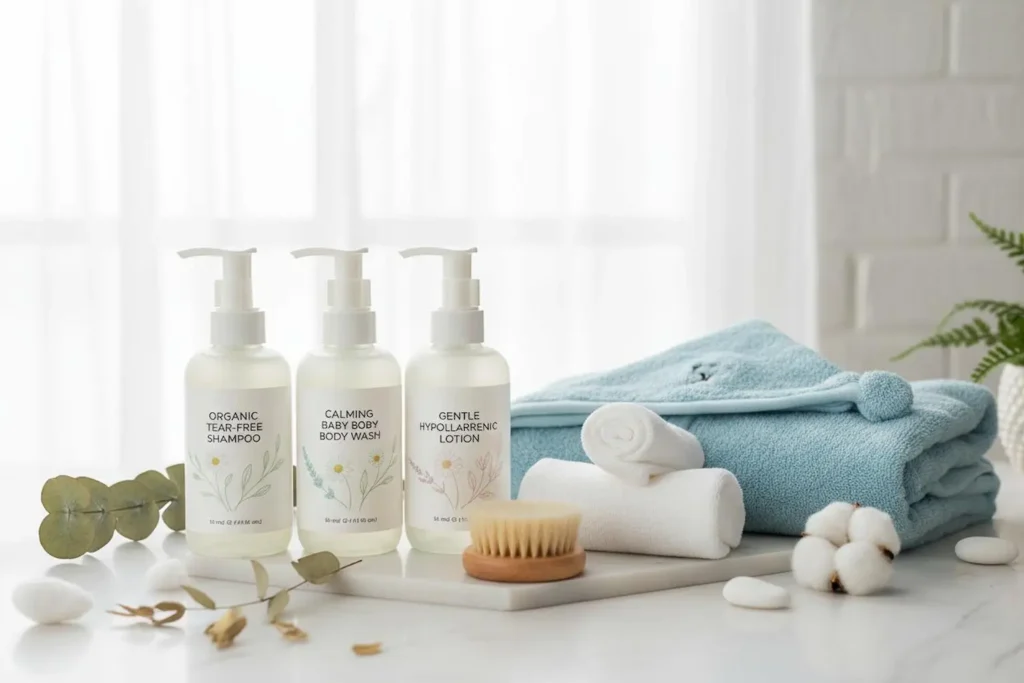
Baby bath products are available in several forms, each designed for a particular purpose. Understanding their functions can help parents avoid purchasing unnecessary products and choose essentials that meet their baby’s needs.
1.1 Baby Soap and Body Wash
Baby soaps and body washes are designed to remove dirt, sweat and everyday impurities from the skin.
They are available in different forms, including:
- Baby soap bars: Solid cleansing products that are used with water during bathing.
- Baby body washes: Liquid cleansers that are applied using the hands or a soft washcloth.
- Head-to-toe washes: Products designed to cleanse both the baby’s body and hair.
When comparing these products, look for gentle cleansing formulas that are suitable for infants. Products with strong fragrances or harsh cleansing properties may not be appropriate for every baby’s skin.
1.2 Baby Shampoo
Baby shampoos are formulated to clean the scalp and hair while helping to avoid unnecessary irritation.
Parents should compare:
- Gentleness of the cleansing formula.
- Fragrance and other added ingredients.
- Age suitability mentioned on the packaging.
- Ease of rinsing.
- Manufacturer’s usage instructions.
A separate shampoo is not always necessary for a newborn, as plain water may be sufficient initially. Parents should introduce additional products according to their baby’s age and needs.
1.3 Baby Lotions and Moisturisers
Baby lotions and moisturisers help maintain the skin’s softness and reduce dryness.
Common options include:
- Lightweight baby lotions.
- Moisturising creams.
- Thicker ointment-based products.
The right choice depends on the baby’s skin condition, product formulation and individual requirements.
1.4 Baby Massage Oils
Some parents use baby oils for massage and moisturising.
When choosing an oil, check its ingredients, fragrance and age suitability. Avoid assuming that natural or herbal oils are automatically suitable for every baby.
Do not apply oils or other skincare products to a newborn without considering age-specific guidance from a healthcare professional.
1.5 Protective Creams and Other Essentials
Other products may include protective creams, diaper-area care products and gentle cleansing wipes.
These products serve different purposes and should not automatically be treated as substitutes for ordinary bathing products.
Parents should purchase them according to their baby’s actual needs rather than collecting a large number of products simply because they are marketed as baby-care essentials.
2. Comparing Baby Bath Products: Soap and Body Wash
Baby soaps and body washes are among the most frequently purchased bathing products. However, not all formulations have the same cleansing properties or ingredients.
Before choosing one, consider the following factors.
2.1 Check the Cleansing Formula
A gentle cleanser should remove everyday dirt without leaving the skin feeling excessively dry.
Parents may compare:
- The type of cleansing agents used.
- Whether the formula is designed for babies.
- The presence of added fragrances.
- Whether the product is easy to rinse off.
- The manufacturer’s recommended age range.
Avoid choosing a product simply because it produces more foam. A rich lather does not necessarily indicate better cleansing or greater suitability for delicate skin.
2.2 Compare Fragrance and Added Ingredients
Fragrance can make a product smell pleasant, but it may irritate some babies, particularly those with sensitive skin.
Consider fragrance-free options when selecting everyday cleansers.
Parents should also remember that products described as unscented may still contain ingredients intended to mask other smells. Reading the ingredient list is therefore more useful than relying only on the front label.
2.3 Consider Liquid Washes and Soap Bars
Both formats have advantages and practical limitations.
| Comparison factor | Liquid body wash | Baby soap bar |
|---|---|---|
| Application | Convenient to dispense | Requires direct application or a washcloth |
| Storage | Usually kept in a bottle | Requires a suitable soap dish |
| Portability | Easy to carry, depending on packaging | Generally compact |
| Usage | Often convenient for daily routines | Can be convenient for simple bathing |
| Cost comparison | Depends on bottle size and quantity | Depends on weight and number of bars |
There is no universally better option. Parents should compare the ingredients, price per unit, packaging and ease of use before making a decision.
3. Baby Shampoo: Ingredients and Features to Consider
When comparing baby bath products, parents should choose a shampoo that gently cleans the baby’s scalp and hair without relying on brand names or fragrance alone.
3.1 Look for Gentle Cleansing Properties
Baby shampoos should be appropriate for the child’s age and intended use.
Parents should consider products that:
- Are specifically formulated for babies.
- Have clear directions for use.
- Can be rinsed easily.
- Do not leave the scalp feeling excessively dry.
- Avoid unnecessary fragrance when the baby’s skin is sensitive.
A product labelled tear-free may be convenient, but this claim does not mean that shampoo cannot irritate a baby’s eyes.
Always take care to avoid contact with the eyes and follow the manufacturer’s instructions.
For additional guidance on caring for a baby’s skin and hair, consult the American Academy of Dermatology’s baby-care recommendations.
3.2 Understand the Difference Between Shampoo and Body Wash
Some baby products are marketed as combined hair and body washes.
These can be convenient because parents do not need separate bottles for every bathing requirement.
However, compare their formulations and intended uses rather than assuming that every multipurpose wash is equally suitable for all babies.
For many newborns, a complicated bathing routine is unnecessary. Plain water and limited use of an appropriate mild cleanser may be sufficient.
3.3 Check Packaging and Ease of Use
Practical features can make bathing easier for parents.
Consider:
- Secure and leak-resistant caps.
- Easy-to-handle bottles.
- Convenient dispensing mechanisms.
- Clear ingredient information.
- Suitable bottle sizes for home use or travel.
Choose packaging that can be handled safely during bathing without requiring parents to leave the baby unattended.
4. Baby Bath Products: Understanding Ingredients and Product Labels
Reading product labels is one of the most useful steps when comparing baby bath products.
The ingredient list provides information that is not always obvious from the product’s name, packaging or advertising.
4.1 Understand Common Ingredient Groups
The following table explains some commonly encountered ingredient categories.
| Ingredient category | Purpose | What parents should consider |
|---|---|---|
| Cleansing agents | Help remove dirt and impurities | Choose gentle formulations appropriate for babies |
| Glycerin | Helps attract and retain moisture | May be included in moisturising products |
| Emollients | Help soften the skin | Compare formulation and suitability |
| Fragrance | Adds a pleasant smell | May irritate some sensitive skin |
| Preservatives | Help prevent microbial contamination | Their presence is not automatically a safety concern |
| Plant extracts and essential oils | Added for fragrance or other product purposes | Natural ingredients can also cause irritation in some individuals |
Parents should not assume that every chemical-sounding ingredient is harmful or that every plant-based ingredient is safe.
The suitability of a finished product depends on its formulation, quality, intended use and the baby’s individual response.
4.2 Check for Fragrance and Potential Irritants
Fragrance-free products are generally a sensible starting point for babies with sensitive skin.
Certain fragrances, essential oils and botanical extracts may trigger irritation in susceptible individuals.
Parents should pay particular attention when introducing a new product to a baby who has previously experienced dryness, redness or irritation.
Avoid choosing products only because they contain words such as herbal, natural or organic.
4.3 Understand Common Marketing Claims
Baby-care packaging frequently includes attractive claims intended to reassure parents.
Some common examples are:
- Dermatologically tested: Indicates that dermatological testing has been conducted, but parents should check the context and scope of that testing.
- Hypoallergenic: Suggests that the product is formulated to reduce the likelihood of allergic reactions. It does not guarantee that an allergy is impossible.
- Tear-free: Indicates a formulation intended to reduce irritation if it accidentally comes into contact with the eyes.
- Natural or herbal: Refers to the ingredients or product positioning, but does not automatically establish suitability for every baby.
- pH balanced: Refers to the product’s acidity or alkalinity characteristics. It should be considered alongside the complete formulation.
Marketing claims should never replace checking the ingredient list and manufacturer’s instructions.
4.4 Check Manufacturer Information and Expiry Details
Before purchasing any baby-care product, examine the packaging carefully.
Check for:
- Manufacturer or marketer details.
- Complete ingredient information, where applicable.
- Batch or lot identification.
- Manufacturing and expiry or use-before information.
- Net quantity and maximum retail price.
- Product directions and safety warnings.
- Relevant manufacturing or licence details, where applicable.
In India, cosmetics are regulated under the Cosmetics Rules, 2020. Parents should purchase products from reliable retailers and avoid items with damaged packaging, missing information or questionable authenticity.
5. Baby Lotions, Creams and Moisturisers
Bathing and cleansing may sometimes leave a baby’s skin feeling dry. Suitable moisturising products can help maintain skin comfort. Baby bath products and skincare essentials should be selected according to the baby’s skin condition and individual requirements.
However, the choice should depend on the baby’s skin condition rather than fragrance or packaging preferences.
5.1 Compare Lotions, Creams and Ointments
| Product type | General characteristics | Common consideration |
|---|---|---|
| Baby lotion | Relatively lightweight and easy to spread | May suit routine moisturising |
| Baby cream | Usually thicker than lotion | May be preferred for dry areas |
| Baby ointment | Generally thicker and more protective | Can be useful for particularly dry skin |
| Baby oil | Oil-based formulation | Not automatically necessary for everyday skincare |
These products are not interchangeable in every situation. Parents should consider the formulation and seek professional advice if a baby’s skin remains unusually dry or irritated.
5.2 Check the Ingredients Before Purchasing
When comparing moisturisers, look for:
- Ingredients that help retain moisture.
- Suitable emollient components.
- Fragrance-free formulations when sensitivity is a concern.
- Clear instructions regarding age and application.
- Products intended for the particular skincare requirement.
Avoid selecting a moisturiser solely because it promises instant softness or contains a popular natural ingredient.
5.3 Avoid Unnecessary Skincare Products
A baby does not necessarily require several different lotions, creams and oils.
Using too many products can make it difficult to identify which ingredient may be causing irritation if a reaction occurs.
A simple skincare routine using suitable products is often easier for parents to maintain.
6. How to Choose Baby Bath Products for Sensitive Skin
Some babies may experience dryness, redness or irritation after using particular cleansing products.
Sensitive skin requires additional attention when selecting bathing and skincare essentials.
6.1 Prefer Simple, Fragrance-Free Formulations
For babies who are prone to skin sensitivity, consider:
- Mild cleansing products.
- Fragrance-free moisturisers.
- Products with clear ingredient lists.
- Formulations specifically intended for babies.
- Minimal use of unnecessary skincare products.
The American Academy of Dermatology recommends mild, fragrance-free baby soap and shampoo as part of gentle infant skincare.
6.2 Introduce New Products Carefully
Avoid introducing several new products at the same time.
Instead:
- Read the product label carefully.
- Check the recommended age and instructions.
- Introduce one new product at a time.
- Observe how the baby’s skin responds.
- Stop using the product if irritation develops.
A small-area trial may help parents observe a reaction, but it cannot guarantee that a product will be suitable for continued use.
6.3 Be Careful with Babies Prone to Eczema
Babies with eczema may require a more specific skincare routine.
Parents should avoid experimenting with multiple cleansers, fragranced products or essential oils.
A healthcare professional can recommend suitable cleansers and moisturisers according to the child’s condition.
Persistent redness, itching, cracking, oozing or worsening skin irritation should be assessed by a paediatrician or dermatologist.
Parent Tip: When choosing products for a baby with sensitive skin, prioritise the ingredient list and individual skin response rather than the brand’s popularity or advertising claims.
7. Common Mistakes Parents Should Avoid
Choosing baby bath products becomes easier when parents understand which purchasing mistakes to avoid.
Here are some common examples.
7.1 Buying Products Mainly for Their Fragrance
A pleasant fragrance does not necessarily indicate that a product is gentle or suitable for babies.
Compare the formulation rather than selecting products primarily because they smell appealing.
7.2 Assuming Natural Products Are Always Safe
Herbal extracts and essential oils can still cause irritation in some babies.
Check the ingredient list and consider individual skin sensitivity before choosing these products.
7.3 Purchasing Too Many Products
Buying several soaps, washes, shampoos and moisturisers may create unnecessary expenses.
Start with a small number of suitable essentials and add products only when there is a genuine need.
7.4 Ignoring Age Recommendations
Products intended for older children may not be appropriate for newborns.
Always check the manufacturer’s recommended age range and usage instructions.
7.5 Overlooking Expiry Dates and Packaging
Never ignore expiry information or purchase products with damaged seals and packaging.
Avoid using products that have changed in colour, texture or smell, even when they are within the stated expiry period.
7.6 Assuming Expensive Products Are Always Better
A higher price does not automatically indicate better ingredients or suitability.
Compare product quantity, formulation, intended purpose and overall value before buying.
7.7 Using Adult Skincare Products for Babies
Adult soaps, shampoos and skincare products may have formulations that are unsuitable for delicate infant skin.
Choose products designed for the baby’s age and intended use.
8. Final Thoughts: Choosing the Right Baby Bath Products
Choosing suitable baby bath products is about understanding ingredients, comparing formulations and considering the individual needs of your baby’s skin.
A popular brand or attractive package should not be the main reason for purchasing a product. Parents should examine ingredient lists, fragrance, cleansing properties, age recommendations and manufacturer information before making a decision.
For everyday care, a simple routine using appropriate gentle cleansing and moisturising products is often sufficient. There is no need to purchase every product available in the market.
Most importantly, observe how your baby’s skin responds to the products you use. If dryness, irritation or other skin concerns persist, seek advice from a qualified healthcare professional.
By comparing products carefully and avoiding unnecessary purchases, parents can make more informed decisions and establish a comfortable bathing routine for their little ones.
9. Frequently Asked Questions About Baby Bath Products
9.1 How often should I bathe my baby?
Most newborns do not need a full bath every day. Bathing two to three times a week is generally sufficient, while the face, neck, hands, skin folds and diaper area can be cleaned as needed. Follow your healthcare professional’s advice for your baby’s individual requirements.
9.2 Which soap is best for a newborn baby?
A mild, fragrance-free cleanser specifically designed for babies is a sensible option when a cleanser is needed. Plain water may be sufficient for newborn bathing initially. Parents should compare formulations and follow age-specific guidance.
9.3 Are fragrance-free baby products better than scented products?
Fragrance-free products are often a better starting point for babies with sensitive skin because added fragrances may cause irritation in some individuals. However, suitability depends on the complete formulation and the baby’s individual response.
9.4 Is baby shampoo necessary for newborns?
A separate shampoo is not always necessary during the early newborn period. Plain water may be sufficient initially. When shampoo is introduced, choose a gentle product appropriate for the baby’s age and follow its instructions.
9.5 Are natural and herbal baby products always safe?
No. Natural and herbal ingredients can also cause irritation or allergic reactions. Essential oils and botanical extracts may not suit every baby. Always examine the ingredient list rather than relying entirely on natural or herbal claims.
9.6 Should I use baby lotion after every bath?
Not every baby requires lotion after every bath. However, a suitable fragrance-free moisturiser may help when the skin is dry. Choose an appropriate formulation and seek professional advice if dryness persists.
9.7 Can I use the same baby wash for hair and body?
Some products are specifically formulated for both hair and body. These can be convenient, provided the formulation is appropriate for the baby’s age and the manufacturer’s directions are followed.
9.8 What should I avoid when buying baby bath products?
Avoid products with unclear ingredient information, damaged packaging, missing expiry details or unsuitable age recommendations. Parents should also exercise caution with strong fragrances, unnecessary additives and products making unsupported safety claims.
9.9 What should I do if a baby develops irritation after using a bath product?
Stop using the suspected product and seek advice from a paediatrician or dermatologist, particularly if the irritation persists, spreads or worsens. Do not experiment with medicated creams or treatments without appropriate professional guidance.
9.10 What is the most important factor when choosing baby bath products?
The most important considerations are formulation, suitability for the baby’s age, gentle cleansing properties, ingredient transparency and individual skin response. Choose products that meet your baby’s needs rather than purchasing based only on brand popularity or price.
Explore our Bath & Skin Care page for more baby bathing and skincare essentials.
Disclaimer: This article is intended for general informational purposes only and does not replace professional medical advice. Every baby’s skin is different. Consult a qualified healthcare professional if you have concerns about skin irritation, allergies or other skin conditions.
Affiliate Disclosure: Some links on this website may be affiliate links. If you purchase through these links, we may earn a commission at no additional cost to you. We aim to recommend and discuss products transparently so that parents can make informed decisions.