
Choosing a safe baby stroller is an important decision for parents because it plays a significant role in a child’s comfort and safety during everyday outings.
However, choosing a stroller should involve more than comparing attractive designs, colours, prices or popular brands. Parents need to examine important safety features, including the harness, brakes, wheels, frame, folding mechanism and seating arrangement.
A stroller that looks comfortable may not necessarily be suitable for every age group. Newborn babies, for example, require appropriate head and neck support and a seating position approved by the manufacturer for their stage of development.
Before purchasing a baby stroller, parents should understand the different types available and compare their safety features, construction quality, weight capacity and ease of operation.
In this guide, we explain how to choose a safe baby stroller, what essential features to examine, which mistakes to avoid and how to select a practical model that suits your baby’s needs and your family’s lifestyle.
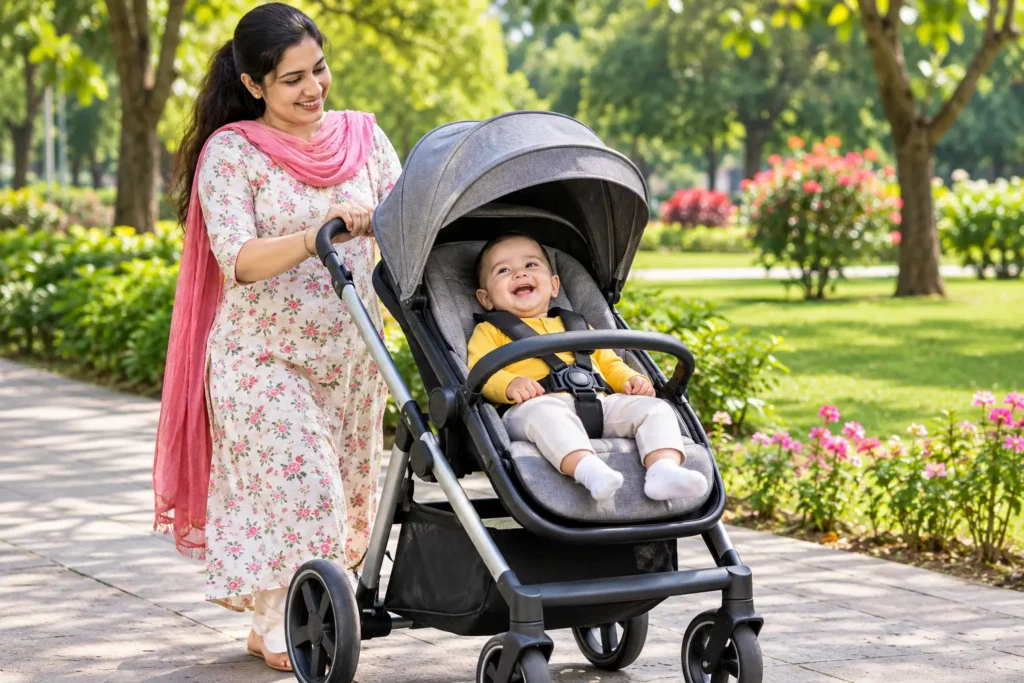
1. Understanding Different Types of Baby Strollers
Baby strollers are available in several designs, each intended for particular age groups, activities and lifestyles. Understanding these options will help parents select a suitable model.
1.1 Full-Size Baby Strollers
Full-size strollers generally have a sturdy frame, a comfortable seat, a larger canopy and a reasonably spacious storage basket.
Common features include:
- Adjustable seating and reclining positions.
- Safety harnesses and secure buckles.
- Lockable wheels and parking brakes.
- Canopies for sun protection.
- Storage baskets for essential baby items.
These strollers are suitable for everyday use, particularly when parents regularly take their babies outdoors.
1.2 Lightweight and Umbrella Strollers
Lightweight strollers are designed for parents who prioritise portability and convenient storage.
Their common characteristics include:
- Lightweight frames.
- Compact folding mechanisms.
- Easy handling and transportation.
- Smaller storage baskets.
- Simple seating arrangements.
They can be useful for travelling and short outings. However, parents should carefully check the age suitability, reclining position, harness and weight capacity before purchasing one.
A lightweight stroller is not automatically suitable for a newborn.
1.3 Travel System Strollers
A travel system usually combines a stroller with a compatible infant car seat and, in some models, a carrycot or bassinet.
The advantage is that parents can move a sleeping baby from a vehicle to the stroller without immediately transferring the baby between completely separate seating arrangements.
Before purchasing a travel system, check:
- Whether the car seat is compatible with the stroller.
- Whether the correct adapters are supplied.
- Whether the car seat locks securely into the stroller frame.
- Whether the car seat is suitable for the baby’s age and weight.
- Whether the manufacturer provides clear instructions for installation and use.
A stroller attachment does not replace the need to use an appropriate car seat correctly when travelling in a vehicle.
1.4 Jogging Strollers
Jogging strollers are designed for parents who want to walk briskly or run with their children.
They commonly feature:
- Three large wheels.
- A sturdy frame.
- A front wheel that can lock for running.
- A hand-operated brake on some models.
- A wrist tether strap.
These strollers are intended for specific activities and should not be treated as ordinary lightweight strollers.
Parents must follow the manufacturer’s minimum age and developmental requirements before running with a baby. Good head and neck control is particularly important, and parents should seek paediatric guidance when uncertain.
1.5 Double and Twin Strollers
Double strollers are designed to accommodate two children. Depending on the model, the seats may be arranged side by side or one behind the other.
Parents should examine:
- The individual weight capacity of each seat.
- Harness arrangements for both children.
- Overall frame stability.
- Footrest design.
- Ease of steering and braking.
- Width and compatibility with doors and lifts.
The stroller must be specifically designed for the number of children it carries. Never add an extra child to an ordinary single stroller.
2. Check the Safety Harness and Buckles
The safety harness is one of the most important features of a baby stroller. It helps prevent a child from slipping, standing up or falling out of the seat. When selecting a safe baby stroller, begin by examining the harness and buckle system carefully.
2.1 Prefer a Five-Point Safety Harness
A five-point harness is generally a preferred safety feature because it secures the child at five positions:
- Two shoulder straps.
- Two waist or hip straps.
- One crotch strap.
These straps come together at a central buckle.
Parents should ensure that the harness is adjustable and can accommodate their growing child. The straps should fit securely without being excessively tight or uncomfortable.
2.2 Examine the Buckle Quality
Before buying a stroller, examine the buckle carefully.
Check whether:
- It locks securely.
- It can be fastened without difficulty.
- It does not release accidentally.
- The straps remain properly attached.
- The material appears durable.
Practise fastening and releasing the harness several times before making your purchasing decision.
2.3 Always Use the Harness
Even during short walks, parents should fasten the harness correctly.
A child may suddenly lean forward, move sideways or attempt to stand up. A properly adjusted harness helps reduce the risk of falls.
Never assume that a young child will remain seated simply because the stroller is stationary.
3. Examine Brakes, Wheels and Stability
A stroller should remain stable while moving and should not roll away when parked. For parents who regularly walk on uneven pavements, a safe baby stroller should have wheels suited to the surfaces they commonly encounter.
3.1 Check the Braking System
The brakes should be easy for parents to operate and should lock the wheels securely.
Look for:
- A reliable parking brake.
- Easy-to-reach brake controls.
- Secure wheel locking.
- A mechanism that cannot be accidentally operated by the child.
Where possible, test the brakes before purchasing. Engage the brake and gently try to move the stroller to confirm that it remains stationary.
Always apply the parking brake whenever the stroller is stopped.
3.2 Examine Wheel Quality
Wheels influence the stroller’s handling, stability and ability to move across different surfaces.
Consider the following:
- Wheels should be securely attached.
- The wheel-locking mechanism should work correctly.
- The stroller should turn without excessive effort.
- The wheels should not wobble or make unusual noises.
- The material should be appropriate for the intended surfaces.
For Indian conditions, parents may prefer wheels that handle ordinary pavements, tiled floors and moderately uneven surfaces comfortably.
However, no ordinary stroller should be assumed suitable for every rough road or outdoor surface.
3.3 Look for a Stable Frame and Wide Base
A stable frame helps reduce the risk of tipping.
Check whether:
- The stroller stands firmly on the ground.
- The frame feels strong and rigid.
- The base is sufficiently wide.
- The wheels remain properly aligned.
- The stroller does not rock excessively.
Avoid models that feel unstable when gently manoeuvred.
For additional stroller safety guidance, consult the American Academy of Pediatrics’ guide to choosing a safe stroller.
4. Inspect the Frame and Folding Mechanism
The folding mechanism should be convenient for parents without compromising the stroller’s structural safety.
4.1 Check the Frame Lock
Many strollers can be folded for transportation and storage.
However, the frame must lock securely when opened.
Check that:
- The locking mechanism engages completely.
- The stroller cannot fold accidentally during normal use.
- The frame remains stable when the child is seated.
- The locking components do not appear damaged or loose.
Parents should practise opening and closing the stroller before purchasing it.
4.2 Examine Hinges and Moving Parts
Folding mechanisms may contain hinges and gaps that can trap small fingers.
Check the positions of moving parts and ensure that the design does not expose the child to unnecessary pinching or entrapment hazards.
Always keep the child away from the stroller while folding or unfolding it.
4.3 Consider Portability
A stroller should also be manageable for the person who will use it regularly.
Consider:
- Overall weight.
- Folded dimensions.
- Ease of lifting.
- Storage space at home.
- Compatibility with your car boot.
- Ease of carrying during travel.
A compact stroller can be useful for urban families, but portability should never take priority over essential safety features.
5. Choose the Right Seat and Reclining Position
A suitable seating arrangement is particularly important for newborn babies, whose head and neck control is still developing.
5.1 Newborn Suitability
Not every stroller is appropriate for newborns.
Choose a safe baby stroller that its manufacturer explicitly approves for newborn use, with an appropriate bassinet, carrycot or suitable fully reclining configuration.
An upright stroller seat may not provide adequate support for a young infant. Check the manufacturer’s age recommendations, reclining instructions and weight limits before placing a newborn in the stroller.
5.2 Examine Seat Support
The seat should provide suitable support for the child’s body.
Look for:
- A supportive backrest.
- A comfortable seating surface.
- Appropriate head support when required by the design.
- Secure side structures.
- Adequate legroom.
- An adjustable reclining arrangement where available.
Avoid adding aftermarket pillows, cushions or mattresses unless specifically approved by the manufacturer.
5.3 Check Reclining Adjustments
An adjustable backrest allows parents to change the seating position according to the child’s age and the manufacturer’s instructions.
The reclining mechanism should lock securely in the selected position.
Never use a reclining setting as a substitute for a safe sleeping surface.
If your baby falls asleep in the stroller, supervise the baby and move them to an appropriate safe sleep space as soon as practical.
6. Consider the Canopy, Ventilation and Weather Protection
A stroller canopy can make outdoor journeys more comfortable by providing protection from direct sunlight and light weather conditions.
6.1 Look for an Adjustable Canopy
An adjustable canopy can help parents provide shade as the sun’s position changes.
Consider:
- Adequate coverage.
- Easy adjustment.
- Secure attachment.
- Durable fabric.
- Convenient operation.
A larger canopy may be useful for regular outdoor outings.
6.2 Check Ventilation
Good ventilation is important, particularly in warm and humid weather.
Parents should look for designs with suitable ventilation panels or breathable materials.
Avoid covering the entire stroller with a thick blanket or cloth, as this can restrict airflow and increase the risk of overheating.
6.3 Consider Rain Protection
Some strollers are supplied with rain covers or compatible weather accessories.
Before purchasing additional accessories, check that they are approved for the particular stroller model and do not interfere with ventilation, visibility or normal operation.
7. Check Weight Capacity and Storage
Every stroller has a specified weight capacity.
Parents should examine the maximum permitted child weight and any separate limits for the storage basket or accessories.
7.1 Follow Weight Recommendations
The stroller should be suitable for the child’s current weight and anticipated growth.
Never exceed the manufacturer’s stated limits.
Also check whether the specifications include separate restrictions for:
- The main seating area.
- A second seat.
- A compatible car seat.
- The lower storage basket.
7.2 Examine the Storage Basket
A storage basket can be useful for carrying nappies, wipes, feeding essentials and other baby supplies.
Look for a basket that is:
- Easily accessible.
- Positioned low on the frame.
- Securely attached.
- Designed for the manufacturer’s permitted load.
Avoid hanging shopping bags or heavy handbags from the stroller handles. Additional weight on the handles can make the stroller unstable and cause it to tip backwards.
8. Test the Stroller Before Buying
Parents should also check the manufacturer’s warranty, availability of spare parts and after-sales service before making their final decision.
It is equally important to select a model that suits the child’s age, weight and development. A stroller designed for a newborn may have different seating requirements from one intended for an older baby or toddler.
Before making a final decision, compare different models, read the manufacturer’s instructions and test the important safety features wherever possible.
A well-chosen stroller, combined with responsible use and regular inspection, can make everyday outings more comfortable and convenient for both parents and children.
Use the following checklist:
| Feature | What parents should check |
|---|---|
| Harness | Secure and adjustable five-point harness |
| Buckles | Reliable locking and release mechanism |
| Brakes | Easy operation and secure parking |
| Wheels | Proper attachment and smooth movement |
| Frame | Strong, rigid and stable construction |
| Folding lock | Secure locking when opened |
| Seat | Suitable support and age suitability |
| Canopy | Adequate coverage and ventilation |
| Storage | Secure basket with stated weight limit |
| Instructions | Clear assembly, operating and safety guidance |
Parents should also ask the retailer about the manufacturer’s warranty, availability of spare parts and after-sales service.
These considerations are particularly useful when buying a stroller that will be used frequently.
9. Essential Baby Stroller Safety Tips for Parents
Even a well-designed stroller requires correct handling and regular inspection.
Follow these precautions during everyday use.
9.1 Never Leave Your Baby Unattended
Always remain close to your child while using a stroller.
Never leave a baby unattended, even when the parking brake is engaged.
9.2 Apply the Brakes Whenever You Stop
Use the parking brake whenever you stop, including when adjusting the seating position or attending to your child.
A stroller can roll away on a slight slope if its brakes are not applied.
9.3 Avoid Overloading
Do not hang heavy bags, shopping items or handbags from the handles.
Use the designated storage basket and follow its maximum weight limit.
9.4 Keep Hands and Feet Away from Moving Parts
Keep your baby’s fingers and toes away from wheels, hinges and folding mechanisms.
Remove your child before folding, unfolding or making major adjustments to the stroller.
9.5 Avoid Using Strollers on Escalators
Use an elevator or suitable ramp wherever possible.
Never attempt to carry a stroller containing a child on an escalator.
9.6 Do Not Use the Stroller as a Regular Sleeping Space
A stroller is not a replacement for a suitable baby cot or other approved safe sleep surface.
If your baby falls asleep while travelling, supervise the baby and transfer them to a safe sleep space as soon as practical.
9.7 Inspect the Stroller Regularly
Check the following components periodically:
- Harness straps and buckles.
- Brakes and wheel locks.
- Tyres and wheel attachments.
- Folding mechanism.
- Frame joints.
- Seat fabric and stitching.
Stop using a stroller if an important safety component is damaged or not functioning properly.
10. Common Mistakes to Avoid When Buying a Baby Stroller
Parents sometimes concentrate on appearance and convenience while overlooking essential safety considerations.
Here are some common mistakes to avoid.
Choosing a stroller only because of its appearance: Attractive designs and popular brands do not automatically guarantee safety.
Ignoring the harness system: A secure and adjustable harness is essential for preventing falls.
Buying an unsuitable stroller for a newborn: Always check the age recommendation and approved seating position.
Overlooking the braking system: Brakes should be easy to operate and secure enough to prevent unwanted movement.
Ignoring folding locks: An unreliable frame-locking mechanism can create a serious safety risk.
Hanging heavy bags on the handles: Additional weight may cause the stroller to tip backwards.
Purchasing unnecessary accessories: Extra cushions, mattresses or unapproved attachments may create additional hazards.
Ignoring maintenance: Damaged straps, loose wheels and faulty brakes should never be overlooked.
A careful comparison before purchasing can help parents avoid these mistakes.
11. Frequently Asked Questions About Baby Strollers
11.1 What is the safest type of baby stroller?
There is no single stroller design that is safest for every child and situation. Parents should select a model appropriate for the baby’s age, weight and development, with a secure harness, reliable brakes, a stable frame and properly functioning locking mechanisms.
11.2 Is a five-point harness necessary for a baby stroller?
A five-point harness is a preferred safety feature because it secures the child at the shoulders, hips and crotch. Parents should use the supplied harness correctly on every journey.
11.3 Can a newborn baby use a regular stroller?
Not every stroller is suitable for newborns. Parents should select a model specifically approved for newborn use, with an appropriate bassinet or reclining arrangement and adequate support. Always follow the manufacturer’s instructions.
11.4 Which is better: a lightweight stroller or a full-size stroller?
The choice depends on family requirements. Lightweight strollers are convenient for travel and storage, while full-size models may offer more storage, larger canopies and additional reclining options. Safety and age suitability should remain the priority.
11.5 Are three-wheel strollers safer than four-wheel strollers?
Not necessarily. Both designs can be suitable when properly designed and manufactured. Parents should compare stability, braking performance, wheel quality and ease of steering rather than choosing based only on the number of wheels.
11.6 What should parents check in stroller brakes?
Parents should check whether the parking brake engages securely, prevents unwanted movement and is easy to operate. They should also ensure that the child cannot easily release the brake mechanism.
11.7 Can a baby sleep in a stroller?
A stroller should not be used as a regular or unsupervised sleeping space. If a baby falls asleep during an outing, maintain supervision and move the child to a suitable safe sleep surface as soon as practical.
11.8 How often should a baby stroller be inspected?
Parents should perform a quick safety check before use and inspect important components regularly. Pay particular attention to the harness, wheels, brakes, frame and folding locks.
11.9 Is it safe to buy a second-hand baby stroller?
A second-hand stroller may be considered if it is in good condition and has all its original safety components and instructions. Check for damage, missing parts, product recalls and the availability of the manufacturer. Avoid models with unknown histories or faulty safety mechanisms.
11.10 What is the most important factor when choosing a baby stroller?
The most important consideration is the overall safety and suitability of the stroller for your baby. Examine the harness, brakes, frame stability, age recommendations and manufacturer instructions before considering additional convenience features.
Conclusion
Choosing a safe baby stroller involves balancing safety, comfort, convenience and practicality. Parents should look beyond attractive designs and promotional claims and carefully examine the product’s construction, harness, braking system, wheel stability and seating arrangements.
It is equally important to select a model that suits the child’s age, weight and development. A stroller designed for a newborn may have different seating requirements from one intended for an older baby or toddler.
Before making a final decision, compare different models, read the manufacturer’s instructions and test the important safety features wherever possible.
A well-chosen stroller, combined with responsible use and regular inspection, can make everyday outings more comfortable and convenient for both parents and children.
Explore our Travel & Gear collection for baby strollers and other useful travel essentials.
Disclaimer: This article is intended for general informational purposes only. It does not replace professional product-safety advice or the manufacturer’s instructions. Always follow the stroller’s age, weight and usage recommendations. Consult your paediatrician if you are uncertain whether a particular stroller or seating arrangement is suitable for your baby.
Affiliate Disclosure: Some links on this website may be affiliate links. If you purchase through these links, we may earn a commission at no additional cost to you. We aim to recommend and discuss products transparently so parents can make informed decisions.